Air and Water Quality Home Page Air & Water Quality, water filters, water softeners, radon mitigation ...
About Air & Water Quality IncTechnical Documentation regarding Air & Water issuesRelated Service ProvidersFrequently Asked Air and Water QuestionsFind the help you need hereWhat's new at AWQ?Links to other helpful sitesArticles of interestContact the Team at Air & Water Qualtiy 
Air and Water Quality Products
Air and Water Quality Services
Search the Air and Water Quality Web Site
Send a link of this page to a friend


Reprinted From Water Technology Magazine (click here to see original article)

MTBE threats to water mount

Growing consumer problems fail to tip scales.

Summary: Some water treatment dealers have been able to capitalize on the need for treatment of groundwater sources contaminated with gasoline additive methyl tertiary-butyl ether (MTBE). Many dealers are still waiting for a ground swell of consumer interest.

By Robert Pini


Air and Water Quality Inc. in Windham, ME, bills itself as a company that tackles the most difficult water treatment problems. Last spring when elevated levels of methyl tertiary-butyl ether (MTBE), a suspected cancer-causing additive used in gasoline to increase octane values, were reported in the local water supply, the dealership found itself facing some alarming problems.

Gas tank leaks apparently had polluted public water supply wells serving 3,000 local residents. Tests in two private wells in nearby Standish turned up more signs of MTBE contamination.

Initial samples in both areas showed MTBE in excessive levels - from three and four times higher than state standards of 35 parts per billion (ppb) to more than 185 times the standard in one test.

Residents complained of foul tasting and smelling water. Families in the most contaminated sites were advised by the state Department of Environmental Protection (DEP) not to use the water for anything except flushing toilets.

Maine residents are not alone. In recent months, MTBE has been found in contaminated water in several states including California, Virginia and Maryland.

In the face of public outcry over the incidents in Maine, Governor Angus King requested the DEP speed up a sampling program to test 800 public water supply wells and 1,000 private wells statewide.

At that point, relying on its ability to take on difficult water treatment problems, Air and Water quickly got involved.

"We were putting in residential systems to treat and remove MTBE within a week after the spills had been detected," says the company's sales engineer Eric Wilson, who participated in the technical planning. "The state said 'develop a plan of action,' and okayed it in a matter of a couple of days."

According to Wilson, the job has turned out to be both demanding and rewarding. There was a steep learning curve as the company organized to react, followed by the daily grind of a heavy work load.

"We made calculations for air stripping and catalytic carbon filtering, based on throughputs and flow rates,'' says Wilson. "Some residential units needed pretreatment to get rid of iron and manganese.''

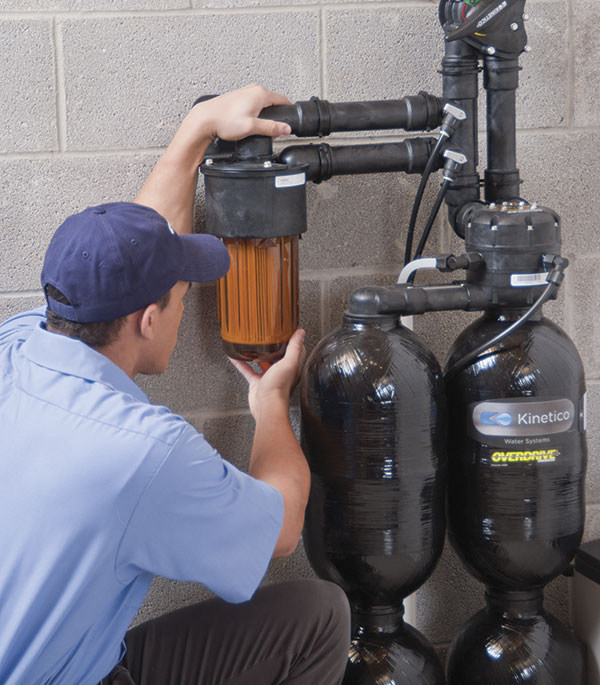
For air stripping, Wilson says that efficient models are commercially available, although some of the treatment systems they install have only the carbon filtration stage. The carbon filter canisters are 4 cubic feet large and also quite efficient at removing MTBE.

"Technically it's working very well," Wilson says. "For the wells (in Standish) with 6500 parts per billion of MTBE, we're taking it down to 3 parts per billion."

Wilson estimated that residential units cost about $8,000 each. He says that customers initially balked at the price, but in the end felt it was a good investment. "If you don't have good water, you can't sell your home," Wilson says.

For many in Maine, cost may not be much of an issue anyway. According to state regulations, if a homeowner's well turns up foul, the state pays for the cleanup or treatment, which includes installation, maintenance and testing, as long as the pollution was not self-inflicted.

A booming business?

While MTBE remediation has become a busy sideline for Air and Water, other dealers are not getting much business from this problem. The reason why is not clear, because MTBE has been reported in water systems throughout the country where it is used, and often in amounts that threaten public health.

In fact, despite a list of incidents spanning nearly two decades, involving gas spills and MTBE contamination in different parts of the country, public concern among consumers is not taking hold.

California is a good example. The state has experienced many fuel spills where MTBE wound up in the drinking water, but dealers there report the market for carbon filtration and air stripping systems has not increased as a result.

In one of the most serious spills, MTBE was detected in municipal wells serving Santa Monica in August 1995. Leaks from underground storage tanks eventually caused seven of Santa Monica's 11 wells to be closed, forcing the city to pipe in water from adjacent districts.

Yet Bill Wallace, the president of RWS Corp., Santa Monica, CA, says this severe water problem has not translated into new demand. "The city has its own water system," he says. "I haven't had anyone with MTBE coming to me."

Mark Felton, the vice president of Culligan Water Conditioning in Sacramento, CA, says he recently received questions from consumers regarding MTBEs.

"I had inquiries from four homes in a remote area with a gas station tank leak, but otherwise I have no firsthand experience with it,'' he says.

MTBE sources and spills


MTBE may not be a household word, but a large number of American households use the chemical, which has been added to gasoline to make it burn cleaner since the 1970s.

During the 1990s, even more MTBE has been added to each tank of gas to help cities and states meet federal standards established by the Clean Air Act Amendment to reduce carbon monoxide, ozone and smog. Total levels of MTBE in gas have climbed during that time from around 2 percent to more than 11 percent.

Chris Kelley, a spokesperson for the American Petroleum Institute, says many states use MTBE.

"It's required primarily around big cities,'' says Kelley. "Some states use a mixture of MTBE and ethanol, and in other states it's required only part of the year. That makes it hard to say exactly how much MTBE is in each gallon of gas."

The US Environmental Protection Agency (EPA) estimates that 70 percent of all the gasoline in the United States contains MTBE at varying concentrations.

Future sales


Whether water treatment dealers will see increasing business to treat MTBE is not yet certain. Early signs indicate MTBE treatment may be a new line of business for some dealers.

Leaky underground fuel tanks are one of the main sources of MTBE contamination. The EPA reports there are more than 1 million underground storage tanks nationwide.

Only a few states are moving to make a leak less likely by requiring double-wall construction and leak alarms. Even with those protections overfilling can still send MTBE splashing into groundwater.

Automobile accidents are also sources of MTBE spills. Since the chemical does not stick, or adhere, to soil, it passes quickly into groundwater where it dissolves completely and spreads rapidly throughout water systems. For example, Maine DEP officials believe an auto accident last winter - with, at most, 20 gallons of gas involved - accounted for the polluted wells this past spring in Standish.

Bruce Hunter, a hydrogeologist for the Maine DEP, says that MTBE has been detected in Maine groundwater as far back as 1984. Since 1991, 306 wells in the state have been contaminated with detectable amounts. He estimates that a quarter have exceeded the state standard of 35 parts per billion.

"If it (MTBE) gets into an aquifer with high permeability, it can take two to three years to clean up,'' he says. "It can take even longer if it gets into clay or fractured rock."

In California, Lawrence Livermore National Laboratory estimated recently that MTBE may have contaminated 10,000 sites in the US.

Maine and California are not alone in reporting MTBE contamination. Other states in the northeast and mid-Atlantic, such as Delaware, New Jersey and New Hampshire are detecting the chemical in groundwater in increasing amounts.

No rush to judgment


Despite these reports, regulatory agencies and consumers seem to be taking a wait-and-see approach.

Use of MTBE has helped to reduce lead levels in children, and it has helped clear the air of smog and pollutants. In the face of these benefits, scientists and researchers want to reserve judgment until they give MTBE a long hard look.

Moreover, the health risks seem to be minimal as yet. The EPA has no standard for MTBE, although it has issued an advisory setting the safety level at 20 to 40 parts per billion, the level at which some people can taste and smell MTBE.

"You'll taste it long before it'll make you sick," says Dave Schmidt, a spokesman for the EPA's western regional office in San Francisco. "If anyone is suspicious and their water tastes like turpentine, then test for MTBE and other gasoline components."

In Maine, few people are calling for a ban on MTBE, or a phase-out of its use. But as the number of leaks in California grows, many there say they have had enough of the additive.

The California environmental group, Communities for a Better Environment, has filed suit against the largest oil companies doing business in the state. The group is seeking a ban against MTBE and to force oil companies to clean up contaminated drinking water sources.

Meanwhile, as the MTBE saga plays itself out, water treatment dealers across the country will, like Air and Water, benefit from being able to tackle difficult treatment problems.

Robert Pini is a free-lance writer in Bennington, VT.

Looking for more information on this topic? Please visit www.waternet.com and click on "article archives." Use the following suggested keywords in an article search: activated carbon, EPA and MTBE.


All Content Copyright 1998
National Trade Publications Inc.


A site in Standish Maine
Home | Top of page | Contact

© Copyright 2000, Air & Water Quality, Inc.
Maine's Water Experts